

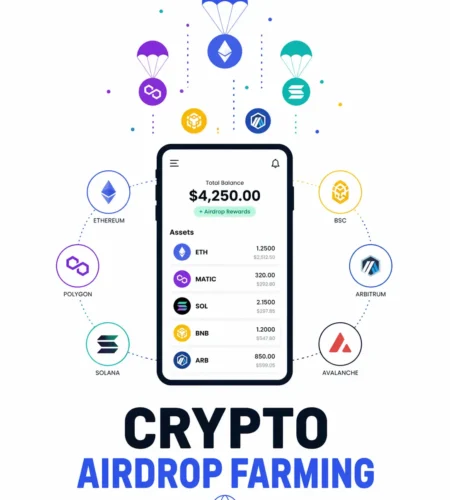
Crypto airdrop farming has emerged as one of the most rewarding strategies in cryptocurrency, with projects distributing billions of dollars in free tokens to early participants. From Uniswap’s $2.6 billion distribution to Hyperliquid’s $7.5 billion airdrop, these token launches have created life-changing wealth for engaged users. As 2026 unfolds, the landscape has matured significantly — projects now use sophisticated AI-powered detection systems to reward genuine users while filtering out coordinated farming operations.
This guide walks you through the fundamentals of crypto airdrop farming, from understanding how airdrops work to executing a practical farming strategy that aligns with 2026’s evolved ecosystem. Whether you’re looking to earn free tokens from upcoming launches or simply want to understand this emerging income strategy, you’ll find actionable steps to get started.
Before diving in, it’s worth noting that airdrop farming isn’t a get-rich-quick scheme. It requires patience, consistent on-chain activity, and a solid understanding of security best practices. However, for those willing to invest time and learn the ropes, it represents a legitimate way to accumulate crypto assets — one that has already rewarded dedicated participants with substantial returns.
If you’re interested in other ways to earn free crypto, our comprehensive guide covers additional strategies including faucet platforms, staking, and passive income opportunities.
What Is Crypto Airdrop Farming?
How Airdrops Work
A crypto airdrop is the distribution of free tokens to wallet addresses that meet specific criteria defined by a project. Projects use airdrops as a community-building mechanism, rewarding early users who have demonstrated genuine interest and engagement with their ecosystem. The logic is straightforward: by distributing tokens to active users, projects create a decentralized token holder base while generating buzz and adoption.
There are several types of airdrops to understand:
- Retroactive airdrops reward users for past on-chain activity. These are typically the most valuable since they recognize early adopters who used protocols before any token was announced.
- Testnet rewards go to participants who test new protocols during their development phase, providing valuable feedback and stress testing.
- Quest-based airdrops require users to complete specific tasks through platforms like Galxe, Zealy, or Crew3 — often social media engagement, referral programs, or on-chain interactions.
- Holding-based airdrops distribute tokens to users who hold certain assets in their wallets at a snapshot date.
How Airdrop Farming Has Evolved
The airdrop farming landscape has transformed dramatically over the past few years. Between 2021 and 2023, qualification criteria were relatively simple — users could earn tokens by completing basic tasks or holding specific assets. This era saw some participants accumulate substantial rewards with relatively minimal effort.
From 2024 onward, projects began implementing sophisticated anti-Sybil measures. Point systems became ubiquitous, with projects like Hyperliquid, Lighter, and Aster distributing hundreds of millions in points that would later convert to tokens. These systems tracked user activity over time, weighting consistent engagement more heavily than burst activity.
By 2026, the ecosystem has reached a new level of sophistication. Approximately 85% of new airdrops now include AI-powered anti-Sybil detection, using graph analysis to identify coordinated multi-wallet farming operations. Notably, around 48% of Arbitrum’s token drop was initially allocated to Sybil farms — a mistake subsequent projects have worked hard to prevent. Today’s airdrops reward genuine, consistent usage rather than clever farming tactics.
Notable Airdrops That Changed the Game
Understanding past airdrops provides valuable context for developing your farming strategy. Here are the most significant distributions that have shaped the industry:
| Project | Token | Total Value | Per-User Range | Key Eligibility Criteria |
|---|---|---|---|---|
| Uniswap | UNI | ~$2.6B | $400-$5,000+ | Trading history, liquidity provision |
| Hyperliquid | HYPE | ~$7.5B | Up to $100K | Trading volume, consistency |
| Arbitrum | ARB | ~$1.2B | $1,200-$2,500 | Bridge usage, contract interactions |
| LayerZero | ZRO | ~$1.8B | $2,000-$10,000+ | Cross-chain messaging volume |
| EigenLayer | EIGEN | ~$1.4B | $800-$5,000+ | Restaking participation |
| Starknet | STRK | ~$700M | $500-$3,000+ | Testnet participation, StarkEx usage |
| zkSync | ZK | ~$650M | $300-$2,000+ | Bridge users, swaps, NFTs |
| Jupiter | JUP | ~$920M | $50-$10,000+ | Solana DEX swap activity |
| Optimism | OP | ~$250M+ | $100-$1,500 | Governance participation, bridge activity |
What Made These Airdrops Successful
Looking at the most successful airdrop recipients, several patterns emerge. First, genuine usage patterns over time consistently outperformed short-term intensive farming. Users who had interacted with protocols consistently across months — rather than those who flooded in during a single week — received higher allocations.
Second, multi-protocol interaction within a single ecosystem proved valuable. For example, Arbitrum users who bridged assets, used multiple DEXs, provided liquidity, and engaged with lending protocols received substantially higher allocations than those who only performed a single type of transaction.
Third, early adoption mattered significantly. In most cases, users who were active in the earliest days of a protocol received the highest multipliers. This is why consistent engagement with emerging projects — even before they announce tokens — remains the most effective farming strategy.
How to Start Airdrop Farming in 2026
Step 1 — Set Up Your Wallet Infrastructure
Your wallet setup is the foundation of your farming operation. For EVM-compatible chains (Ethereum, Arbitrum, Base, Optimism, Avalanche), MetaMask remains the standard choice. For Solana, Phantom offers excellent integration with DeFi protocols. Consider setting up multiple wallets to separate your farming activities from your main holdings.
Using a burner wallet strategy is essential for security. Create dedicated wallets specifically for farming activities, keeping them separate from wallets holding significant value. This limits your exposure if a protocol is compromised or if you accidentally interact with a malicious contract.
You’ll need to fund your wallets with modest amounts for gas. For low-fee chains like Base or Arbitrum, $100-200 in ETH per wallet covers transaction fees for months of activity. For Solana, similar amounts in SOL work well. Ethereum mainnet requires more substantial capital — $500-2000+ — due to higher gas costs.
Step 2 — Choose 2-3 Ecosystems (Don’t Spread Thin)
The most critical strategic decision is which ecosystems to focus on. The principle of “deep farming over wide farming” cannot be overstated. Rather than attempting to participate across dozens of chains superficially, concentrate your efforts on 2-3 ecosystems where you can build genuine, consistent activity.
Low-fee options make excellent starting points. Solana offers $1-200 in transaction costs for most activities. Base provides sub-penny gas fees, making it incredibly cheap to execute frequent transactions. Arbitrum and Optimism similarly offer low-cost environments suitable for building activity history.
Premium chains like Ethereum mainnet require more capital but often deliver higher-value airdrops due to the larger capital requirements for participation. Consider allocating a portion of your farming budget here once you have experience.
Testnets represent the lowest-cost entry point. Many projects — including Monad, Berachain, and MegaETH — are currently in testnet phase and have indicated that active testnet participants will receive preferential treatment when tokens launch.
Step 3 — Build Consistent On-Chain Activity
Consistency is the currency of modern airdrop farming. Projects now track time-weighted activity, meaning six months of regular usage carries more weight than six days of intensive farming. Establish a weekly routine that builds genuine on-chain history:
- Monday: Check for new protocol launches, bridge assets if needed, participate in any governance votes
- Wednesday: Execute 2-3 token swaps on your priority ecosystems, using different trading pairs
- Friday: Adjust liquidity positions, explore new dApps, interact with emerging protocols
- Monthly: Review your portfolio, revoke unnecessary token approvals, adjust your strategy
Target at least 5 protocols within each ecosystem you’re farming. This multi-protocol interaction demonstrates genuine ecosystem engagement rather than single-protocol farming. Additionally, activities like crypto staking can count as qualifying on-chain activity for many airdrop programs.
Core Farming Strategies That Work in 2026
Testnet Participation
Testnet farming offers the lowest barrier to entry — it requires zero capital but can yield substantial rewards. Projects actively seek testnet participants who provide valuable feedback, report bugs, and help stress-test protocols. Unlike mainnet farming, testnet participation often receives generous rewards specifically because it involves effort beyond simply holding assets.
Current testnet-active projects worth participating in include Monad (a $244M funded parallel EVM L1), Berachain (a Cosmos-based L1 with significant DeFi focus), and MegaETH (a $107M funded project pushing L2 performance boundaries). These projects have explicitly stated that testnet contributors will receive preferential treatment in any future token distribution.
DeFi Protocol Interaction
Engaging with decentralized finance protocols forms the backbone of most airdrop farming strategies. The key is diversity — perform token swaps across multiple trading pairs rather than repeatedly swapping the same pair. This demonstrates more sophisticated usage patterns.
Liquidity provision, even with modest amounts like $50-100, can qualify you for higher allocation tiers. Many protocols reward users who provide liquidity to their pools, as this contributes to protocol stability and trading volume. Similarly, lending and borrowing activities demonstrate sophisticated DeFi usage that projects increasingly reward.
If you’re new to DeFi, our guide to yield farming provides a comprehensive introduction to these strategies and how they can simultaneously build your airdrop profile.
Cross-Chain Bridging
Bridge protocols track your bridging activity over time, making consistent cross-chain usage a valuable farming signal. When bridging, use official bridges rather than third-party aggregators when possible — this creates clearer on-chain evidence of your activity.
Bridge meaningful amounts rather than dust. Projects can distinguish between genuine bridging activity and minimal farming transactions. If you’re bridging $50+ consistently over months, you’re demonstrating real utility of the bridge rather than just chasing rewards.
Governance and Community Participation
On-chain governance participation has become an increasingly important airdrop criterion. Voting on Snapshot proposals or directly on protocols like Compound, Aave, or MakerDAO demonstrates community engagement that projects value.
Beyond on-chain voting, active participation in project Discords — providing constructive feedback, participating in discussions, and contributing to governance proposals — can strengthen your profile. Some projects explicitly track Discord engagement as part of their allocation criteria.
Quest and Points Platforms
Quest platforms like Galxe, Zealy, and Crew3 offer structured ways to earn recognition from projects. These platforms host official campaigns where completing tasks — social media engagement, referrals, on-chain interactions — earns credentials that projects can use in their allocation calculations.
Points programs have become ubiquitous, with DEXs and other protocols issuing points that will eventually convert to tokens. The Hyperliquid model — where trading points translated to substantial token allocations — has inspired similar programs across the industry. Adopt a portfolio approach: allocate roughly 70% of your farming effort toward projects with confirmed or highly likely drops, and 30% toward speculative opportunities.
Gas Fees and Capital Requirements
Understanding the capital requirements for different farming strategies helps you allocate resources effectively. Here’s a breakdown of typical costs:
| Strategy | Capital Needed | Gas Fee Range | Time Commitment |
|---|---|---|---|
| Testnet only | $0 | $0 | High |
| Low-fee chains (Solana, Base) | $50-200 | <$0.01/tx | Medium |
| Multi-chain | $200-500 | Varies | Medium |
| Ethereum mainnet | $500-2000+ | $1-20+/tx | Low-Medium |
To minimize gas costs, prioritize L2 networks like Base and Arbitrum where transaction fees are minimal. Time your transactions strategically — gas prices often dip during weekend hours. Consider batching multiple interactions into single transactions when possible.
Building up initial capital for gas fees can be challenging if you’re starting from zero. Platforms like FaucetWorld, which has operated for over seven years, can serve as a practical source for accumulating small amounts of crypto to cover initial gas fees when starting your airdrop farming journey. For those exploring broader passive income strategies, combining multiple earning methods can accelerate your farming budget.
Airdrops to Watch in 2026
Several high-profile projects are either confirmed for token launches or widely expected to distribute tokens in 2026. Here’s a summary of the most anticipated opportunities:
| Project | Category | Funding | What to Do | Status |
|---|---|---|---|---|
| MetaMask | Wallet/Infra | ConsenSys backed | Use swaps, bridge, hold diverse portfolio | Unconfirmed |
| Base | L2 | Coinbase | Use Base App, Aerodrome, Aave, NFTs on Zora, Far caster | Speculative |
| Polymarket | Prediction Market | $70M+ | Trade prediction markets, provide liquidity | Confirmed token |
| Monad | L1 | $244M | Testnet participation, early mainnet usage | Testnet active |
| MegaETH | L1/L2 | $107M | Testnet feedback, early adoption | Testnet phase |
| Berachain | L1 | $100M+ | Testnet, DeFi interaction | Testnet active |
It’s important to note that these are speculative opportunities. While some projects like Polymarket have confirmed token launches, others may never distribute airdrops. Treat each as a potential bonus rather than a guaranteed return, and focus on building genuine activity across ecosystems regardless of whether tokens materialize.
Risks and Scams to Avoid
Common Airdrop Scams
The airdrop space attracts significant scam activity. Understanding common attack vectors is essential for protecting your assets. Phishing claim sites proliferate after airdrop announcements — scammers create convincing fake websites that mimic official claims pages. Always verify URLs carefully and never click links in unsolicited messages.
“Pay to claim” scams are particularly prevalent. Scammers demand payment in exchange for releasing airdropped tokens — legitimate airdrops never require upfront payment. If you’re asked to send crypto to receive crypto, it’s a scam.
Malicious token approvals represent a sophisticated threat. Scammers airdrop worthless tokens to thousands of wallets, hoping users will interact with them and inadvertently grant unlimited spending access to their wallets. Never interact with unexpected tokens in your wallet — if something appears unexpectedly, leave it alone.
Dusting attacks involve tiny amounts of crypto sent to your wallet, often with malicious links in the transaction memo. These are designed to trick you into visiting phishing sites. Similarly, wallet drainer contracts like Inferno Drainer have stolen over $80 million from victims through malicious contract interactions.
Red Flags Checklist
Before engaging with any airdrop-related opportunity, verify against these warning signs:
- Requests for your seed phrase or private key — never share these
- Upfront payment requirements to claim tokens
- Unsolicited direct messages about “exclusive” airdrops
- Misspelled domains or missing HTTPS
- Guaranteed return promises
- Pressure to act immediately without time to research
Security Best Practices
Protecting yourself requires consistent security habits. Use dedicated burner wallets specifically for farming activities, keeping them separate from wallets holding significant value. Regularly revoke unnecessary token approvals at Revoke.cash — this prevents malicious contracts from accessing your funds even if you’ve interacted with them in the past.
Bookmark official URLs and never click links in DMs or emails. Enable a hardware wallet for any position exceeding $1,000 — the added security is worth the inconvenience. And perhaps most importantly, remember the 88% statistic: research shows the majority of airdropped tokens lose substantial value within three months of launch. Plan your exit strategy accordingly, and consider selling a significant portion early unless you have strong conviction in the project.
Many of these scam patterns overlap with those documented in our Crypto Faucet Scams guide — the same bad actors often target both communities.
Frequently Asked Questions
How much money do I need to start airdrop farming?
You can start with testnets at zero cost. For low-fee chains like Solana or Base, $50-200 per wallet is sufficient for months of activity. A multi-chain farming strategy typically requires $200-500, while Ethereum mainnet farming demands $500-2000+ due to higher gas costs.
Is airdrop farming legal?
Yes, airdrop farming itself is legal. However, earnings may be taxable depending on your jurisdiction. Most tax authorities treat airdropped tokens as taxable income at their fair market value when received. Consult a tax professional for guidance specific to your situation.
How long does it take to see rewards from airdrop farming?
Most airdrops require 3-12 months of consistent activity before token launches. Projects typically track historical on-chain activity, so early engagement is essential. Patience is crucial — trying to game the system with short-term activity typically results in lower allocations or exclusion entirely.
Can I farm airdrops without any upfront investment?
Yes. Testnet participation requires only time, not capital. Quest platforms like Galxe and Zealy also offer opportunities to earn project recognition without financial investment. While the returns may be smaller than capital-backed farming, these zero-cost options provide legitimate entry points.
What is Sybil detection in airdrops?
Sybil detection refers to projects’ efforts to identify coordinated multi-wallet farming operations. Modern projects use AI and graph analysis to examine transaction patterns, wallet relationships, and behavioral signals. Approximately 85% of new airdrops now include some form of anti-Sybil filtering, making genuine, consistent usage the most effective farming approach.
Should I hold or sell airdropped tokens?
Research indicates that approximately 88% of airdropped tokens lose value within three months of launch. While some tokens like UNI and ARB have held value well, the majority underperform. Consider selling a significant portion early to secure gains, while retaining a position if you believe in the project’s long-term potential.
Conclusion
Airdrop farming in 2026 rewards consistency, genuine engagement, and patience over clever farming tactics. The landscape has evolved significantly — projects now use sophisticated AI detection to identify and reward authentic users while filtering out coordinated operations. Success requires choosing 2-3 ecosystems, building consistent on-chain activity over 6+ months, and maintaining rigorous security practices.
It’s essential to approach airdrop farming with realistic expectations. Not every project will launch tokens, and many of those that do will see their token values decline rapidly. However, for those willing to invest the time and effort, the asymmetric risk-reward profile remains attractive — the downside is limited to your time and modest capital, while the upside can be substantial.
If you’re capital-constrained, start with testnet participation on projects like Monad or Berachain — zero cost, potential high reward. If you have some capital to work with, pick one ecosystem, build genuine usage across multiple protocols, and let time do the rest. The next wave of airdrops is coming — those who prepare now will be best positioned to benefit.
For more information on earning free crypto through various strategies, explore our guide to earning crypto the easy way or learn about passive income opportunities in the crypto space.