

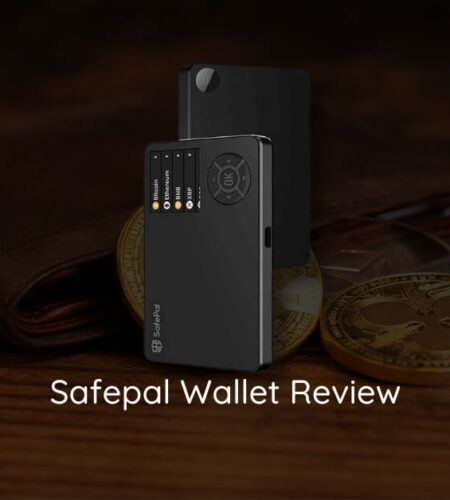
Choosing a hardware wallet usually means deciding between security and affordability. Premium devices from Ledger and Trezor dominate the market, but their prices have climbed steadily over the years. SafePal positions itself as the alternative: a hardware wallet backed by Binance Labs that retails for a fraction of what competitors charge.
The question is whether that lower price comes with meaningful compromises. This review examines SafePal’s hardware models, air-gapped signing mechanism, supported assets, and the ongoing debate around its closed-source firmware to help you decide if it fits your security requirements.
For users who earn cryptocurrency through faucets and micro-earning platforms, choosing the right storage wallet matters just as much as choosing where to earn. Platforms like FaucetWorld, which has operated for over seven years, let users withdraw small amounts of crypto regularly—and those earnings need a secure destination.
Air-Gapped QR Code Signing
SafePal’s defining security feature is its air-gapped transaction signing. Unlike hardware wallets that connect via USB or Bluetooth, SafePal devices never establish a direct data connection with any computer or smartphone. Instead, transactions are signed offline and transmitted via QR codes displayed on the device screen.
Here is how the process works in practice:
- You initiate a transaction in the SafePal mobile app (available for iOS and Android).
- The app displays a QR code containing the unsigned transaction data.
- You scan that QR code with the SafePal hardware wallet’s built-in camera.
- You verify the transaction details on the hardware wallet screen and confirm with your PIN.
- The hardware wallet signs the transaction offline and displays a new QR code.
- You scan the signed QR code back into the mobile app, which broadcasts it to the network.
This method eliminates the attack surface associated with USB connections, Bluetooth pairing, and WiFi exposure. The private keys never leave the device, and there is no physical data pathway for malware to exploit. The trade-off is that the QR code scanning process adds a few extra seconds to each transaction compared to USB-based signing.
SafePal S1 Hardware Wallet
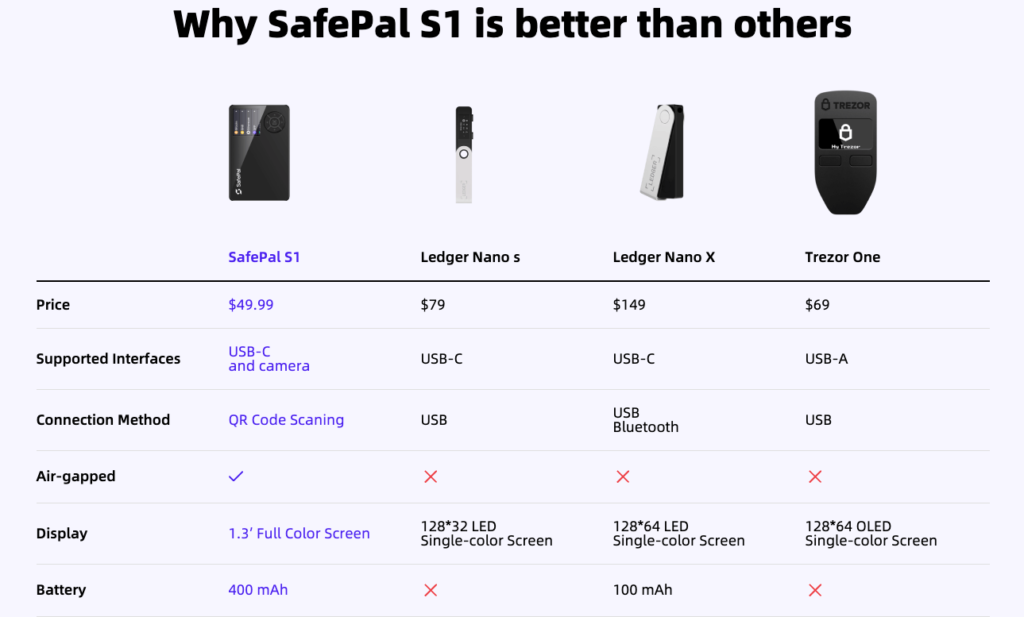
The SafePal S1 is the company’s flagship hardware wallet, priced at approximately $49.99. At that price point, it significantly undercuts the Ledger Nano S Plus ($79) and Trezor Safe 3 ($79), making it one of the most affordable cold storage options available.
Hardware Specifications
- Display: 1.3-inch OLED screen for transaction verification
- Connectivity: USB-C port (charging only), no Bluetooth or WiFi
- Security chip: EAL 6+ certified Secure Element
- Anti-tamper: Self-destruct mechanism that wipes keys if physical tampering is detected
- Recovery: Supports 12, 18, and 24-word seed phrases
- PIN protection: 6-digit PIN required for each signing session
The S1 feels compact and lightweight. The build quality is functional rather than premium—plastic housing with a small but readable screen. The camera module for QR code scanning is built into the device, and the USB-C port is used exclusively for charging the internal battery.
SafePal S1 Pro and Expanded Product Line
SafePal has expanded its hardware lineup beyond the original S1. The S1 Pro offers the same core air-gapped security with improved hardware specifications, including a larger display and better camera for faster QR code scanning. The device maintains the same QR-based signing workflow but addresses some of the usability limitations of the original S1.
SafePal has also introduced complementary products like the SafePal Cypher, a metallic seed phrase backup plate designed to protect recovery words from fire and physical damage. While not a wallet itself, it addresses a common vulnerability: seed phrases stored on paper are susceptible to environmental damage.
Supported Assets and Mobile App
SafePal supports over 10,000 cryptocurrencies and tokens across dozens of blockchain networks. This includes major assets like Bitcoin, Ethereum, Solana, BNB, and XRP, as well as ERC-20, BEP-20, and SPL tokens. The wide asset support is one of SafePal’s practical advantages—users with diversified portfolios rarely need to worry about compatibility.
The SafePal mobile app serves as the companion interface for the hardware wallet. Key features include:
- Portfolio tracking: Real-time balances and price data across all held assets
- In-app swapping: Built-in exchange functionality via third-party aggregators
- dApp browser: Access to decentralized applications and DeFi protocols
- Staking: Native staking support for select proof-of-stake assets
- Multi-language support: Available in over a dozen languages
The app also supports creating software-only wallets (without the hardware device) for users who want to manage smaller balances with convenience. However, the security benefits of the hardware wallet are only realized when transactions are signed on the physical device.
The Closed-Source Controversy
This is the most significant concern surrounding SafePal, and it deserves honest discussion. Unlike Trezor, whose firmware is fully open-source, SafePal’s firmware is closed-source. This means independent security researchers cannot audit the code that runs on the hardware wallet.
The implications are worth understanding clearly:
- No independent verification: Users must trust SafePal’s claims about how private keys are generated, stored, and used. There is no way for a third party to confirm that the device does not leak keys or contain backdoors.
- Update risks: Firmware updates could theoretically introduce vulnerabilities. Without source code review, users rely entirely on SafePal’s integrity.
- Supply chain trust: The anti-tamper self-destruct mechanism provides some protection against physical tampering during shipping, but the closed-source nature means you cannot verify the full security model.
SafePal mitigates some of these concerns through its Binance Labs backing, which provides institutional credibility, and the EAL 6+ certified secure element chip. But for users who prioritize verifiable security over affordability, open-source alternatives like Trezor remain the stronger choice.
SafePal vs Ledger vs Trezor
Placing SafePal in context with established hardware wallet brands highlights where it excels and where it falls short.
Price Comparison
- SafePal S1: ~$49.99
- Ledger Nano S Plus: ~$79
- Trezor Safe 3: ~$79
- Ledger Nano X: ~$149
SafePal wins on price, often costing 40-65% less than comparable devices. For users on a budget who want cold storage rather than keeping funds on an exchange or in a hot wallet, SafePal provides an entry point that competitors do not match.
Security Model Differences
Ledger uses a closed-source Secure Element with USB/Bluetooth connectivity and a strong track record. Trezor offers fully open-source firmware with USB connectivity but lacks a Secure Element chip. SafePal combines an EAL 6+ Secure Element with air-gapped QR signing—a technically sound approach, but one that remains unaudited by the broader security community due to its closed-source firmware.
Pros and Cons
Advantages
- Lowest price among mainstream hardware wallets at $49.99
- Air-gapped QR code signing eliminates USB and Bluetooth attack vectors
- EAL 6+ certified Secure Element chip
- Support for over 10,000 tokens across dozens of blockchains
- Binance Labs backing provides institutional credibility
- Anti-tamper self-destruct mechanism for physical security
Limitations
- Closed-source firmware prevents independent security audits
- QR code scanning adds friction compared to USB-based signing
- No desktop application—requires a mobile phone for all operations
- Smaller developer community than Ledger or Trezor
- Limited third-party wallet integration compared to competitors
Frequently Asked Questions
Is SafePal a safe wallet?
SafePal uses an EAL 6+ certified Secure Element chip and air-gapped QR code signing, which are strong security measures. The device never connects to the internet, and private keys never leave the hardware. However, its closed-source firmware means independent researchers cannot audit the code, which is a legitimate concern for security-focused users. Binance Labs backing provides some institutional assurance, but users must decide whether closed-source hardware meets their personal risk tolerance.
How does SafePal compare to Ledger?
SafePal costs significantly less ($49.99 vs $79+ for Ledger) and uses air-gapped QR signing instead of USB or Bluetooth. Both use Secure Element chips, though Ledger has a longer track record and broader third-party wallet compatibility. Ledger’s firmware is also closed-source, but it has undergone more extensive third-party security audits. SafePal is the better budget choice, while Ledger offers more mature ecosystem integration.
Does SafePal support NFTs?
Yes, SafePal supports NFT management through its mobile app. You can view, send, and receive NFTs on supported blockchains including Ethereum, Solana, and BNB Chain. The hardware wallet can be used to authorize NFT transactions securely via the QR code signing process.
What happens if my SafePal device breaks?
If your SafePal hardware wallet is lost, damaged, or stops working, you can restore your funds using your seed phrase on any compatible wallet. SafePal uses standard BIP-39 recovery phrases (12, 18, or 24 words), which means you are not locked into SafePal’s ecosystem. You can import the seed phrase into another BIP-39-compatible wallet to regain access to your assets. This is why securing your seed phrase backup is critical.
Conclusion
SafePal delivers genuine hardware wallet security at a price point that makes cold storage accessible to a wider range of users. The air-gapped QR code signing mechanism is technically sound, the EAL 6+ Secure Element provides strong hardware-level protection, and support for over 10,000 tokens covers virtually any asset a user might hold.
The closed-source firmware remains the primary drawback. Users who value transparency and community verification should consider open-source alternatives like Trezor. But for those who prioritize affordability and are comfortable trusting SafePal’s Binance-backed security claims, the S1 and S1 Pro represent solid value in the hardware wallet market.
This review is for informational purposes only and does not constitute financial advice. Always conduct your own research before choosing a cryptocurrency storage solution.